

Knowledge
HPLC analysis: a key technology for quality control
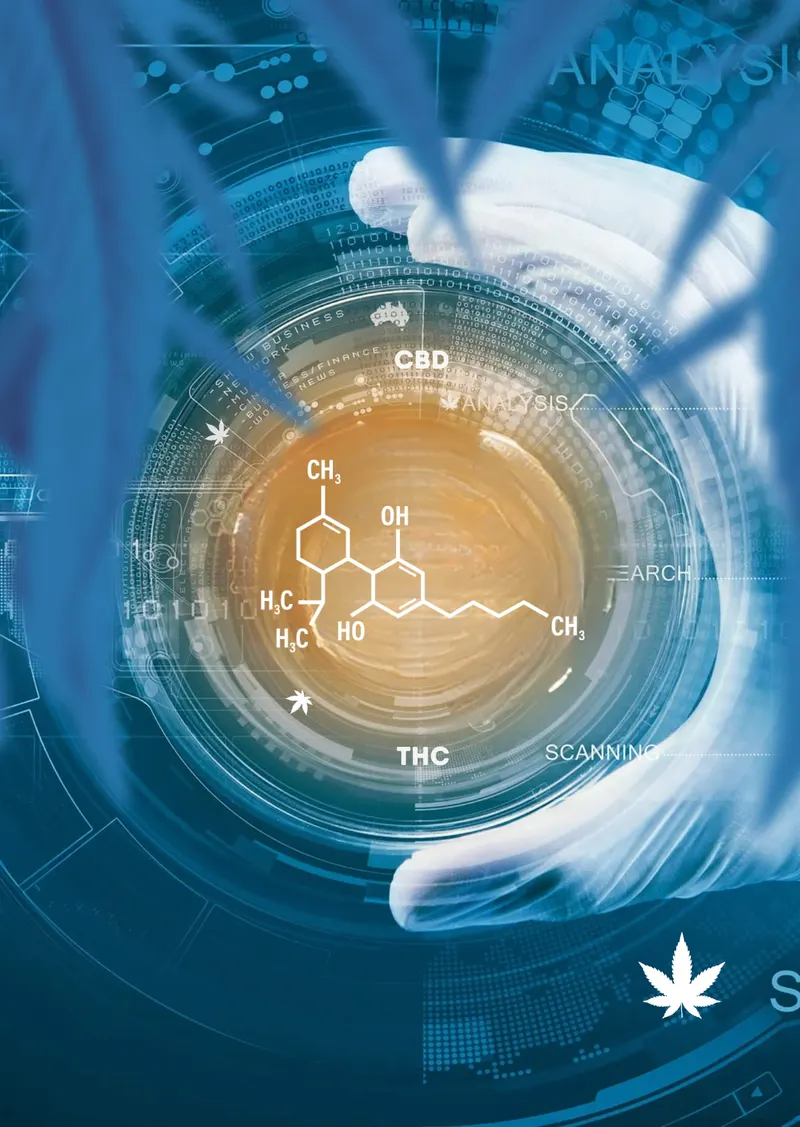
1. Introduction to HPLC analysis
High-performance liquid chromatography (HPLC) is one of the most important analytical methods in the modern cannabis industry. The technique is used to determine the chemical composition of cannabis products accurately, in particular the concentrations of cannabinoids and terpenes, which are responsible for the medical and psychoactive effects of cannabis. In an increasingly regulated industry, HPLC analysis is essential for ensuring the quality and safety of cannabis products while meeting legal requirements.
2. Fundamentals of high-performance liquid chromatography (HPLC)
2.1 What is HPLC?
High-performance liquid chromatography (HPLC) is a technique for separating, identifying and quantifying the components of a mixture. The method is based on the distribution of analytes between a stationary phase (usually a solid or viscous substance packed into a column) and a mobile phase (a solvent or solvent mixture pumped through the column). HPLC is particularly valuable for analysing substances that are liquid at room temperature or can be brought into solution.
2.2 The principle of HPLC analysis
The basic principle of HPLC is that different compounds in a mixture interact differently with the stationary phase and the mobile phase. These differences cause the compounds to leave the column at different times (elution times), which allows them to be separated and identified. Detection is typically carried out with a UV-Vis detector, which measures the absorbance of the compounds at specific wavelengths and so enables quantitative analysis.
3. The importance of HPLC analysis in the cannabis industry
3.1 Why HPLC for cannabis?
Cannabis contains a wide range of chemical compounds, the most important of which are cannabinoids and terpenes. These substances determine the effect and quality of the end product. HPLC analysis is the preferred method for determining the concentrations of these compounds, as it can separate complex mixtures and accurately quantify individual components. Unlike other methods, such as gas chromatography, HPLC requires no derivatisation and can therefore analyse heat-sensitive cannabinoids such as THC and CBD directly.
3.2 Key analytes in cannabis
The most important analytes measured in cannabis samples by HPLC include:
– Tetrahydrocannabinol (THC): the main psychoactive cannabinoid in cannabis.
– Cannabidiol (CBD): a non-psychoactive cannabinoid with a wide range of medical applications.
– Cannabigerol (CBG): a precursor of THC and CBD that is attracting growing research interest.
– Cannabinol (CBN): a degradation product of THC with mildly sedative properties.
– Terpenes: aromatic compounds responsible for the characteristic smell and taste of cannabis, which may also have therapeutic effects.
4. Preparing cannabis samples for HPLC analysis
4.1 Sampling and homogenisation
The first step in the HPLC analysis of cannabis is sampling. The sample must be representative of the entire batch to ensure accurate results. It is then homogenised so that all parts of the sample are evenly mixed. This is particularly important because cannabinoid and terpene concentrations can vary between different parts of the plant.
4.2 Extraction of cannabinoids
After homogenisation, the cannabinoids are extracted from the sample. This is usually done with a solvent such as methanol, ethanol or acetonitrile. The sample is mixed with the solvent and stirred or treated in an ultrasonic bath to extract the cannabinoids. After extraction, the solution is centrifuged to separate out solid particles, and the supernatant is used for analysis.
4.3 Sample preparation and filtration
Before the extracted samples are injected into the HPLC, they must be passed through a filter with a pore size of 0.2 to 0.45 micrometres to remove impurities and particles that could damage the HPLC column. The samples may also be diluted to keep analyte concentrations within the linear range of the HPLC detectors.
5. Performing HPLC analysis on cannabis
5.1 Choice of column and solvent
Choosing the right HPLC column and solvent is crucial for the successful analysis of cannabis samples. Reversed-phase HPLC columns are typically used, with a non-polar stationary phase and a polar mobile phase (such as water and methanol or acetonitrile). This configuration provides good separation of cannabinoids and terpenes.
5.2 Detection methods in HPLC
The most commonly used detection method in the HPLC analysis of cannabis is the UV-Vis detector. This detector measures the absorbance of light by the analytes at specific wavelengths. THC, CBD and other cannabinoids have characteristic absorption spectra in the UV range, typically at 220 nm or 280 nm. This allows the substances in the sample to be quantified precisely.
5.3 Quantitative and qualitative analysis
After separation and detection, the resulting data are analysed to determine the concentrations of the various analytes. This is done by comparing the peaks obtained with calibration curves prepared from known concentrations of the analytes. HPLC can be used for both qualitative analysis (identifying compounds) and quantitative analysis (determining concentration).
6. Commonly analysed cannabinoids and terpenes
6.1 THC and its derivatives
Tetrahydrocannabinol (THC) is the best-known cannabinoid in cannabis and is responsible for the plant’s psychoactive effects. Alongside THC, its derivatives such as THCA (tetrahydrocannabinolic acid), which is converted into THC when heated, are also analysed. HPLC analysis allows the concentration of these compounds to be determined accurately, which is crucial for quality control and correct dosing.
6.2 CBD and other non-psychoactive cannabinoids
Cannabidiol (CBD) is another important cannabinoid that is increasingly in the spotlight because of its wide range of therapeutic applications. In addition to CBD, other non-psychoactive cannabinoids such as CBG (cannabigerol) and CBC (cannabichromene) are also analysed in cannabis samples. HPLC analysis is particularly useful for determining the purity and potency of CBD products used in medicine and cosmetics.
6.3 Terpene analysis
Terpenes are the aromatic compounds in cannabis that give the plant its characteristic aroma and taste. They also help to modulate the effects of cannabinoids. Terpenes can also be quantified by HPLC, although they are often analysed by gas chromatography (GC). Determining the terpene profile is important for classifying cannabis strains and developing products with specific aroma profiles.
7. Validation and verification of HPLC methods
7.1 Method validation
Validating HPLC methods is a crucial step in ensuring that analytical results are reliable and reproducible. Method validation covers checking the method’s precision, accuracy, linearity, limit of detection (LOD) and limit of quantification (LOQ). A validated HPLC process ensures that results meet legal requirements and that consistent quality standards are maintained.
7.2 Verification of analytical results
In addition to validation, verifying the analytical results is also important. This is done by regularly running control analyses with known reference samples and checking the results for deviations. Proper verification ensures that HPLC methods continue to deliver accurate and precise results in routine operation.
8. Advantages of HPLC over other analytical methods
8.1 Comparison with gas chromatography (GC)
Gas chromatography (GC) is another widely used method for analysing cannabis. Compared with GC, however, HPLC offers several advantages. HPLC does not require derivatisation of the samples, which is particularly beneficial when analysing THCA and other non-psychoactive cannabinoids that could become unstable when heated in GC. In addition, HPLC can analyse a broader range of compounds, including polar and non-volatile substances.
8.2 Advantages over TLC and other techniques
Compared with thin-layer chromatography (TLC) and other conventional methods, HPLC offers greater sensitivity, precision and accuracy. While TLC can be useful for simple, rapid analyses, HPLC enables more detailed and more quantitative analysis, which is of crucial importance in quality control and scientific research in particular.
9. Challenges and solutions in the HPLC analysis of cannabis
9.1 Matrix effects and how to control them
One of the biggest challenges in the HPLC analysis of cannabis is dealing with matrix effects, which can impair the accuracy of the analysis. Matrix effects occur when components of the sample other than the target analytes alter the signal intensity. These effects can be minimised through careful sample preparation, the use of internal standards and optimisation of the HPLC conditions.
9.2 The influence of sample variability
The natural variability of cannabis samples, such as differences in cannabinoid and terpene concentrations between different plants or even within the same plant, is a further challenge. To ensure reliable results, thorough homogenisation of the samples and multiple analyses are required.
10. Future prospects for HPLC analysis in the cannabis industry
10.1 Advances in technology
HPLC technology continues to evolve, leading to faster, more accurate and more efficient analyses. New developments such as ultra-high-performance liquid chromatography (UHPLC) offer even higher resolution and shorter analysis times, which is particularly advantageous in industry, where time is a critical factor.
10.2 Integration into automated systems
As laboratory automation increases, HPLC systems are also increasingly being integrated into fully automated analytical platforms. This enables higher sample throughput while reducing the error rate, further improving the efficiency and reliability of cannabis analyses.
11. Conclusion
11.1 The role of HPLC in assuring cannabis quality
HPLC analysis is indispensable for quality assurance in the cannabis industry. It allows the concentration of cannabinoids and terpenes to be determined accurately and ensures that products comply with legal regulations and are safe for consumption. Without this precise analytical method, it would be difficult to guarantee the quality and safety of cannabis products.
11.2 Its importance for research and development
HPLC also plays a central role in the research and development of new cannabis products. By analysing chemical composition accurately, researchers can develop new strains with specific medical or sensory properties. In the fast-growing cannabis industry, HPLC analysis remains a cornerstone of innovation and quality.